
Shridhar Shukla on teachers, student agency and ed-tech that solves real problems
By Shalini Amin Sheth, for EdTech Society · 20 May 2024
Dr Sugat Dabholkar, Assistant Research Professor at Tufts University, recently interviewed education technology pioneer Dr Shridhar Shukla, Co-founder and Chairman of KPOINT Technologies, for EdTech Society. In the interview, Shridhar makes crucial points about how technology can solve real problems in education, and discusses the role of teachers in shaping the lives and careers of students.
If you often think about what ails education in India, if you are part of the education and ed-tech industry, or if you are a technologist or entrepreneur who likes solving problems, this interview is for you. It raises questions and points that can help the industry through turbulent times and towards solutions that add value.
Key discussion points
- How teachers play a pivotal role in motivating and shaping students, and why we need to focus on up-levelling them
- Why the agency of learning needs to be transferred to students
- The need for competency-based education tools with variation in practice
- How to make a real impact with technology applied to education
Solving problems that matter: the journey of a technologist and entrepreneur
Shridhar’s career cuts across academia, industry and entrepreneurship. An IIT Bombay alumnus, he went on to a PhD at NCSU and taught computer engineering in the US for many years before returning to India as COO of Persistent Systems in Pune. As Co-founder and Chairman of KPOINT Technologies, he now focuses on school education, particularly on upskilling teachers.
He came to education technology from a technology career because he wanted to solve the many unsolved problems in education, and technology was a way to solve them at scale. From building security for software, to building video technology and applying it to education, to using technology to widen reach and engagement while up-levelling teachers, it has been an almost seamless journey for this humble, unassuming problem solver.
Empowering teachers as catalysts for change
Early in the interview, with a gentle nudge from Sugat, Shridhar shares a touching account of how his Grade 7 teacher inspired him to do well simply because she believed in him. He was then in the bottom half of his class; he went on to stand first across all divisions at his Mumbai school, then studied at IIT Bombay and built a successful career as an academic, technologist and entrepreneur. All of it, he says, grew from the spark his Grade 7 teacher created.
Teachers play a crucial role in engaging and motivating students, and we need to support them with professional development and technology. How technology can create more of these moments, where many teachers spark many students in different contexts, is a theme that has guided Shridhar’s work and can inspire education companies, policymakers and entrepreneurs. The vision is an ecosystem where educators are empowered to shape students’ learning.
Transferring the agency of learning to students
Parents usually look for good marks, and teachers and schools are held responsible for them, so much of the school day goes into helping children score better. But a teacher’s most important responsibility is to transfer the responsibility for learning to the student. Knowledge is meant to be generated by students as they learn, and that knowledge can then be applied to the higher-order skills that make them employable.
What does the modern classroom need from teachers?
- Create a learning environment, rather than only impart knowledge
- Teach the basics and fundamentals well
- Once the fundamentals are taught, help students take ownership of their own performance
- Encourage variation in practice, and let students practise higher-order skills
How can the modern classroom flourish?
- Empower and coach educators to put good teaching of fundamentals ahead of external pressures
- Support educators with their routine work
- Let students learn the basics in their preferred language, especially in the early years
Creating tools for competency-based education
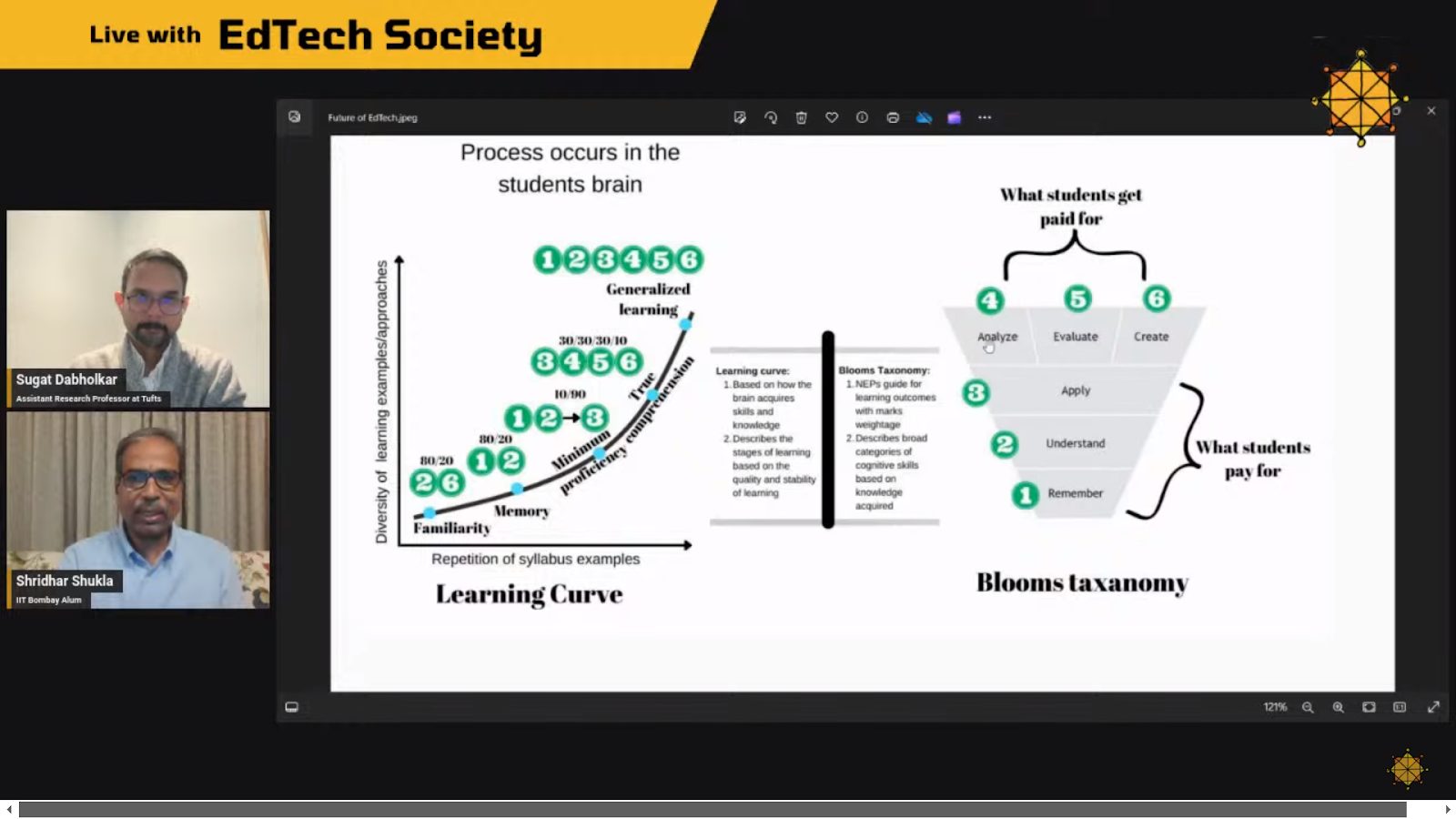
Shridhar explains the importance of competency-based education, using Bloom’s taxonomy to show how cognition and competency develop. Schools tend to focus on Bloom’s levels 1 to 3 (remember, understand, apply), but in the real world it is competence at levels 4 to 6 (analyse, evaluate, create) that makes people employable. Education tools need to shift towards these higher-order skills. Together with variation in practice, this has the potential to inspire better education tools.
The impact of technology applied to education
Shridhar describes how the TV, the computer, the internet, video and now AI have transformed, and continue to transform, teaching and learning, even though none of them was conceived as an educational technology. YouTube, for example, was meant for people to broadcast themselves and has become an educational tool. Understanding this distinction matters when building solutions that make an impact.
Transforming education in India through technology
Using the word “transform” about education implies that something is drastically wrong with it. In many places things are going well, but the challenges are numerous, whether because of short-term thinking, vested interests or sheer diversity.
Advice for ed-tech entrepreneurs
Looking ahead, Shridhar offers points for aspiring ed-tech entrepreneurs and those already in the field. First of all, an ed-tech entrepreneur is an entrepreneur first, and an ed-tech entrepreneur second. Then:
- Develop a deep understanding of the education domain.
- Look for a real problem. Entrepreneurs often build products for perceived problems, and there is a vast difference between a perceived problem and a real one.
- Tell yourself, and everyone you work with, that success will take more time, money and teamwork than you expect.
A compelling vision for the future
At a turbulent time for the ed-tech industry, the interview offers several ideas that can guide us forward. In conclusion:
- As we become more student-centred, we must keep teachers in the loop. Given the impact teachers can have at every level, we need systems that up-level and empower them.
- Knowledge is meant to be generated by students as they learn. We need to help teachers transfer the agency of learning to students.
- We must build competency-based education tools with variation in practice.
- Look for a real problem to solve, not a perceived one.
- To make an impact, understand the human and social aspects first, then apply the right technology to education.
Now it’s time to watch the interview, reflect and be inspired.
Conversations with people shaping ed-tech
Infocus Interviews are EdTech Society’s conversations with educators, researchers and builders in educational technology.